Reshore Now
Comments (0)
February 27, 2026
How and Why to Lower the U.S. Dollar with a Market Access Charge
For decades, the United States has run persistent trade deficits alongside persistent capital account surpluses. This is not a coincidence. By definition, when the U.S. imports more goods than it exports, it must export financial assets in return. Foreign governments, institutions, and investors purchase U.S. Treasuries, stocks, corporate bonds, and real estate — and in doing so, they must first purchase U.S. dollars. That steady demand for dollar-denominated assets keeps the dollar structurally strong.
A strong dollar benefits consumers through cheaper imports and benefits financial markets through strong capital inflows. But it also makes U.S. manufacturing less competitive. Exports become more expensive abroad. Imports become artificially cheap at home. Domestic producers compete not only with foreign labor but with a currency value imbalance.
If the United States is serious about rebuilding its industrial base, reducing trade deficits, and accelerating reshoring, currency policy must enter the discussion. One of the most direct and structurally coherent tools available is a Market Access Charge — a modest levy on foreign purchases of U.S. financial assets.
How it Works A Market Access Charge would function as a capital inflow tax. When foreign investors purchase U.S. Treasuries, equities, or corporate bonds, a small percentage fee would apply. The goal is not to eliminate capital inflows, but to moderate them.
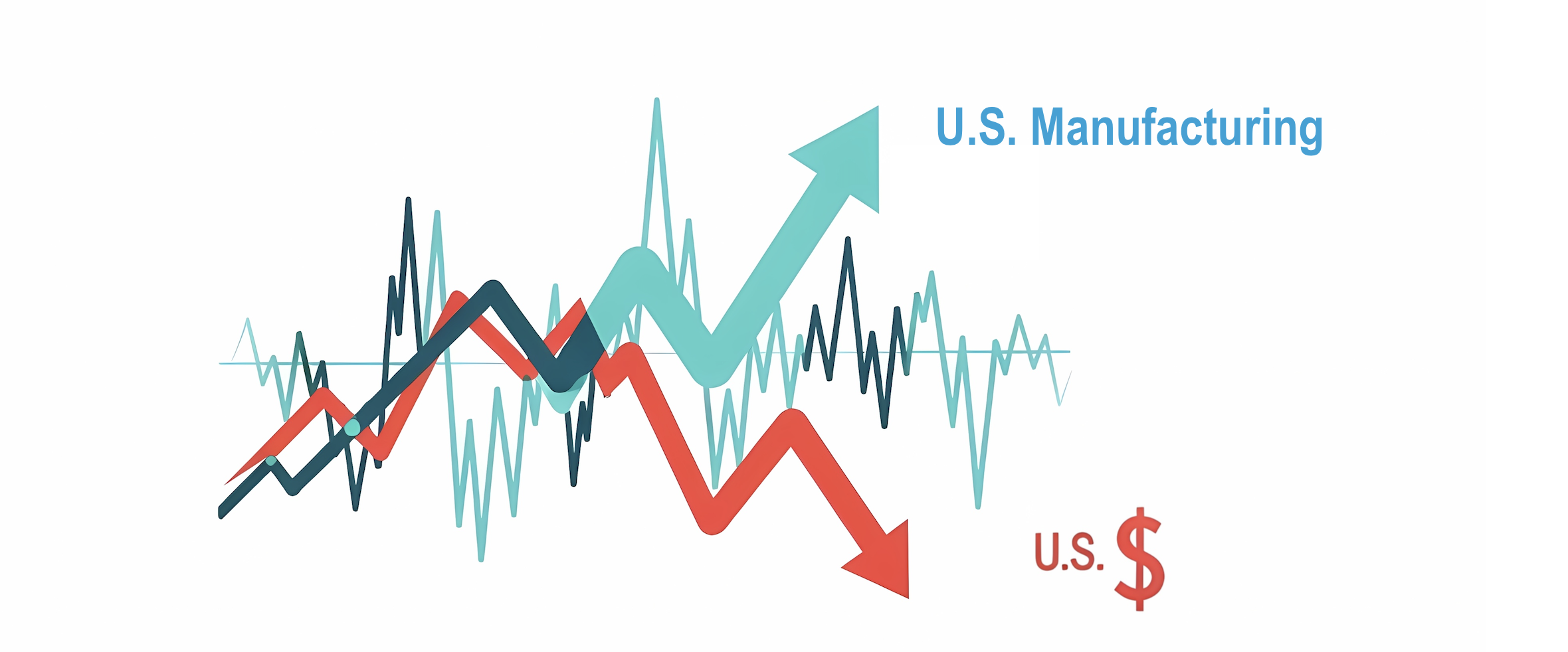
Because foreigners must buy dollars to buy U.S. assets, reducing demand for those assets reduces demand for dollars. Lower demand for dollars results in a weaker exchange rate. A 15–25% depreciation would meaningfully alter global price competitiveness.
This is not a tariff on goods. It is a policy that addresses the root macroeconomic driver behind trade imbalances: excessive capital inflows that keep the dollar elevated.
Why a Weaker Dollar Matters for Manufacturing A 20% lower dollar would:
Make U.S. exports roughly 20% cheaper in foreign currency terms. Make imports more expensive in dollar terms, improving domestic substitution. Raise expected margins for firms producing in the United States. Improve return on investment calculations for new domestic facilities. Research suggests that a 10% depreciation in the dollar can increase manufacturing output by 3–6% over several years. A 20% move could generate a 6–12% structural lift in output and significantly improve capacity utilization. For reshoring decisions — which are often margin-sensitive — this kind of shift can materially alter investment behavior. Instead of relying solely on targeted subsidies or tariffs, a currency adjustment improves competitiveness across all tradable sectors simultaneously: machinery, electronics, auto components, chemicals, and durable goods.
Currency Policy vs Tariffs vs Subsidies Tariffs change relative prices but often raise domestic costs and invite retaliation. Subsidies such as those in the IRA or CHIPS Act target specific industries but require large fiscal outlays and can distort capital allocation. A Market Access Charge addresses the systemic driver. Rather than protecting selected sectors, it improves baseline competitiveness for all tradable industries.
Trade-Offs and Risks A weaker dollar does not come without costs. Reduced foreign demand for Treasuries could raise interest rates. Estimates suggest that a meaningful reduction in foreign purchases might increase long-term yields by 50 to 150 basis points, depending on Federal Reserve policy. Higher rates would increase federal borrowing costs and could pressure asset valuations. Import prices would rise in the short term, potentially adding temporary inflation.
However, the policy would likely shift the composition of capital inflows rather than eliminate them. Portfolio inflows might decline, but productive foreign direct investment into U.S. manufacturing could increase, as facilities become cheaper in foreign currency terms and export competitiveness improves.
The Strategic Question The United States currently benefits from reserve currency status and deep financial markets. These advantages have supported strong asset prices and low borrowing costs. But they have also contributed to structural trade deficits and sustained pressure on domestic manufacturing.
A Market Access Charge represents a structural pivot: from an asset-driven growth model toward a production-oriented model. It recognizes that persistent trade deficits are inseparable from persistent capital surpluses. Lowering the dollar deliberately is not about economic nationalism. It is about correcting a macro imbalance that has reshaped the industrial landscape for decades.
If the objective is a stronger domestic manufacturing base, broader tradable-sector growth, and a narrowing of structural trade deficits, then currency policy deserves a central place in the conversation.
- - -