The Resurgence of Manufacturing: Reindustrialization Strategies in Europe and the U.S. This Capgemini study takes a comprehensive look at how reindustrialization, digital transformation, and sustainability goals are driving a new era of manufacturing in Europe and the United States. cdv Digital Transformation, Enhancing ESG Initiatives Top CPO Priorities for 2026 Digital transformation and environmental, social and governance initiatives are the top priorities for chief procurement officers in 2026. RI comment: Reshoring is the most effective and immediate way to reduce Scope 3, supply chain, emissions for most products. Bessent Rejects Worries Over Dollar’s Decline Diminishing Its Global Role Comments from US Treasury Secretary Scott Bessent about the dollar: “The price of the dollar has nothing to do with a strong dollar policy. The strong dollar policy is, are we doing the things over the long term to ensure that the US dollar remains the reserve currency of the world?” This suggests to Barrow that the policy “no longer means a desire to see the dollar rise,’’ which could undermine the dollar in the future. RI comment: The dollar is down almost 10% YTD 12/20/25. A high USD today will enable larger trade and budget deficits resulting in a weak/collapsing future USD. As a result of our huge ongoing trade deficits, foreign companies and countries already hold $20T more USD and assets than we hold of theirs. The return on those assets goes abroad. NVIDIA Could Use Humanoid Robots to Build Advanced AI Computers In the US Automated assembly using humanoid robots could make U.S. production cost-competitive, positioning NVIDIA as a leader in reshored high-tech manufacturing. Th Inside LG’s Smart Factory A great example of the kind of modernized functionality that makes US domestic production possible and successful.
Survey: American Manufacturers List Economic Challenges Top business challenges are looming trade uncertainties (73.1%); rising health care costs (70.2%), and a weaker domestic economy (60.1%), NAM finds. RI comment: These factors are related. U.S. healthcare costs, at almost 200% of most developed countries, are built into our manufacturing cost structure, making us less competitive. The attempt to become competitive has created uncertainty, weakening the economy. Made in America
As the United States approaches its 250th anniversary in 2026, reflecting on the Declaration of Independence reminds us that the nation’s earliest ideals centered on freedom, self-reliance, and human potential. Those ideals took physical shape through generations of American makers. From 18th-century craftsmen to today’s engineering pioneers, manufacturing has been one of the most tangible expressions of the independence and opportunity envisioned by the founders.
Lincoln on Protective Tariffs “I believe yet, if we could have a moderate, carefully adjusted protective tariff, so far acquiesced in as not to be a perpetual subject of political strife, squabbles … and uncertainties, it would be better for us.” -Abraham Lincoln, Letter to Edward Wallace (1859). At the time, Lincoln believed a protective tariff would be beneficial to American industry, but he also felt that re-raising/re-opening the debate publicly “just then” would not necessarily help the cause or the person who revived it. RI comment: We prefer a lower USD vs. tariffs. A firm, long-term, tariff is much better than no action to address our cost competitiveness problem. What is The New Economic Patriotism? Hint: It’s About the Production “First, the US relation to China has grown surprisingly reminiscent of our pre-19th-century relation to Great Britain. We supply unfinished goods – mainly agricultural products and other ‘produce of the earth’ such as minerals and wood – while China supplies the manufactured goods. This asymmetry is, moreover, like that with Britain before, the product of deliberate policy choices – in this case, clever choices by China and improvident choices by American business and political leaders.”
RI comment: Good job identifying that the U.S. has a trade structure like an emerging market country and needs to be more productive. However, this article fails to mention the underlying problem. USD is overvalued 20% vs. developed countries and 100% vs. China and other EM countries. The best we can do on productivism will not overcome that root problem, therefore his goals will not be achieved. Skilled Workforce
A strong skilled workforce is essential to continued reshoring. Momentum is finally shifting as the U.S. turns this long-standing challenge into a strength. It’s time for companies, EDOs, policymakers, and educators to lean into proven best practices.
CTE Programs Are Expanding Due To Rising Student Demand Career and technical education (CTE) programs are growing quickly. In a recent EdWeek Research Center survey, 61% of educators said their districts have expanded CTE offerings over the past five years. Most educators expect further expansion, including more internships, greater access to industry-recognized credentials, and increased real-world learning experiences. Americans May Return to Working with Their Hands As AI fuels strong GDP growth, many Americans face joblessness, prompting a potential return to hands-on trades and vocational work. RI comment: This is great news. For the worker, no college debt and equal or higher income. For the country, a fix for its most basic problems. Gen Z Revitalizes the Skilled Trades Amid Construction Labor Shortages With Baby Boomers retiring and skilled-labor roles disappearing, Gen Z is stepping up - and redefining construction as the next great career path. RI comment: We need more construction workers to handle the surge in factory construction. China, Trade and Supply-Chain Disruptions
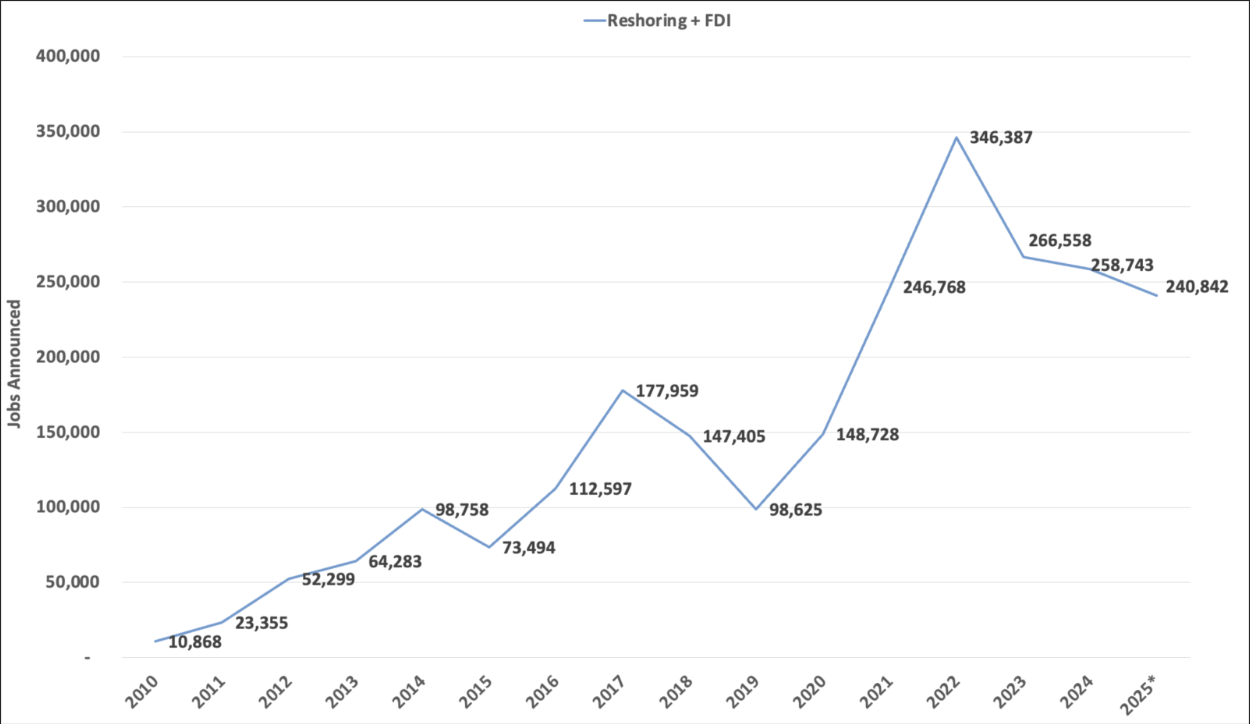
China’s Growth Is Coming at the Rest of the World’s Expense China’s manufacturing surge and export-heavy “dual circulation” model are reshaping global trade, boosting Beijing’s dominance while undercutting foreign industries and deepening international economic divides. RI comment. Excellent WSJ article. The trend has been clear for years. Media and other countries are taking the trend more seriously now that the impact is spreading from the U.S. to many other countries. IMF Wades into Debate Over Yuan, Warns on Risk of Trade Tensions The IMF urges China to adopt bolder stimulus measures to rebalance its economy, a move that could reshape global trade flows and impact supply-chain dynamics. RI comment: China’s 50% currency undervaluation has enabled its competitiveness A higher currency would enrich its citizens and increase imports, balancing trade. Mexico’s New Tariffs Add to Growing Backlash Against Chinese Exports As cheap Chinese goods intensify competitive pressures, governments worldwide are responding with aggressive new tariff measures. Mexico’s Truck Drivers Stage Blockades, Disrupting Trade With US Border delays at the U.S.–Mexico crossing highlight the urgent need for resilient North American supply chains as manufacturers aim to bring production back home. Why Everyone Got Trump’s Tariffs Wrong “In the days following ‘Liberation Day,’ the contrast between Trump’s optimism and more dire predictions from trade experts and economists was stark. While the odds of a recession have fallen below 25%, the U.S. has seen little evidence of large-scale reshoring. Reporters Chao Deng and Drew An-Pham look at six bold predictions Trump, the White House, economists and business leaders made about the economy, what’s happened and what might come next.” RI communicated to Chao and Drew: Excellent article. I agree on most points, especially the negative effect of uncertainty due to the chaotic tariff policy. The non-profit Reshoring Initiative tracks the rate of reshoring and FDI jobs. Our projection calls for 2025 to be down 7% from 2024 at about 240,000 jobs. Conclusion: Not bad given the turmoil, the inevitable lag from policy change to project announcement, the media hype that spooked consumers and companies and that we did not include the $20T of reshoring and FDI projects claimed by the President. This statement seems to be as much your view as the economists’: “A deficit isn’t automatically a red flag for the economy—in fact, it can be a good thing.” But your own statement, “because many supplies and other manufacturing inputs currently needed in the U.S. can only be found abroad,” largely undermines this claim. Clearly, such dependency for the world’s leading country and the “arsenal of democracy” is a “red flag.” One year’s deficit would be manageable. However, the cumulative effect of trade deficits is that foreign entities hold $20T more US assets than we hold of offshore assets. The return on those assets flows abroad instead of being spent or invested here. Our weakened manufacturing base in the U.S. is a major driver of our inability to supply defense materiel at anywhere near the needed rate. Our manufacturing decline is consistent with the declining hegemon condition described by Ray Dalio in Changing World Order: not competitive, less productive, overextended, and large wealth gaps. All of these would be addressed by reshoring. Drew responded, asking for reshoring cases. Select Media Articles: Engineering. Com: Language gaps might threaten the U.S. manufacturing revival Supply and Demand Chain Executive: 5 Trends to Reshape Manufacturing Industry in 2026: Deloitte The Center Square: Reshoring manufacturing will take a more skilled workforce, small manufacturers say Videos and podcasts: Coalition for a Prosperous America: Democrats Keep Anti-Tariff Bias in House Small Business Hearing. Steel And Aluminum Tariffs Criticized by Importers GE Appliances: Harry Moser, Congressional Hearing: Recognized on Capitol Hill: GE Appliances’ Impact on U.S. Manufacturing YouTube: Should Congress Care About These Trade Deficits? Upcoming Events January 6 — MIT Alumni SW Florida — Laural Oaks Country Club, Sarasota, FL January 15 — Steel Tank Institute (STI) — webinar January 27-29 — Wire Harness Mfg. Assoc. — Las Vegas, NV March 10-12 — MFG Meeting — Ft. Lauderdale, FL March 23 — University of WI, Madison supply chain class — remote May 5-6 — COO Leaders’ Summit — Denver, CO September 14-19 — IMTS — Chicago, IL October 14-16 — AMT MT Forecast — Schaumburg, IL Visit ReshoreNow.org for the latest news and upcoming events. |